Hamburg Is First European City to Authorize the Seizure of Private Vacant Buildings to House Migrants
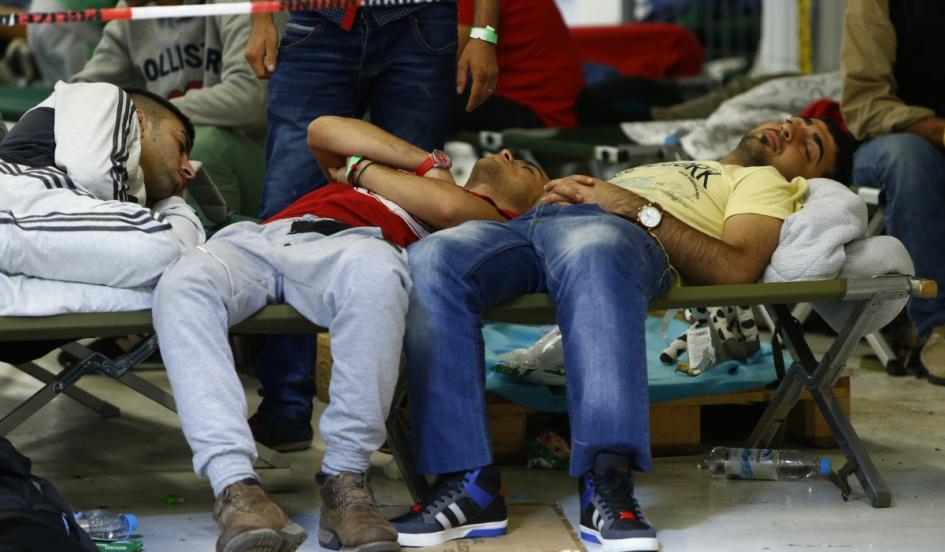
In response to the refugee crisis, the German city of Hamburg has enacted a new law that will enable the government to seize vacant commercial properties to provide temporary housing for refugees. The law will go into effect next and will last until March 2017. Despite the additional measures, many refugees will die of exposure during the cold German winter
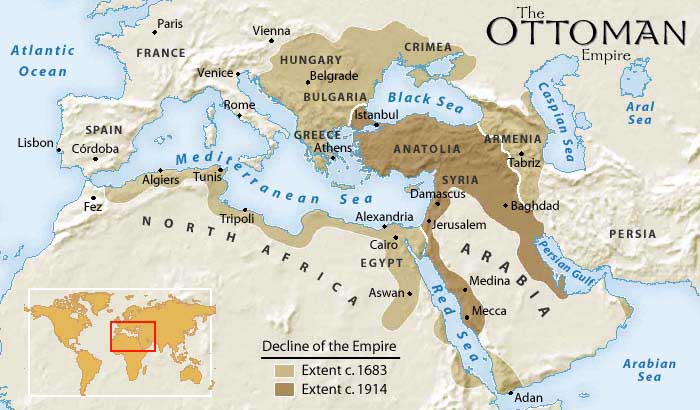
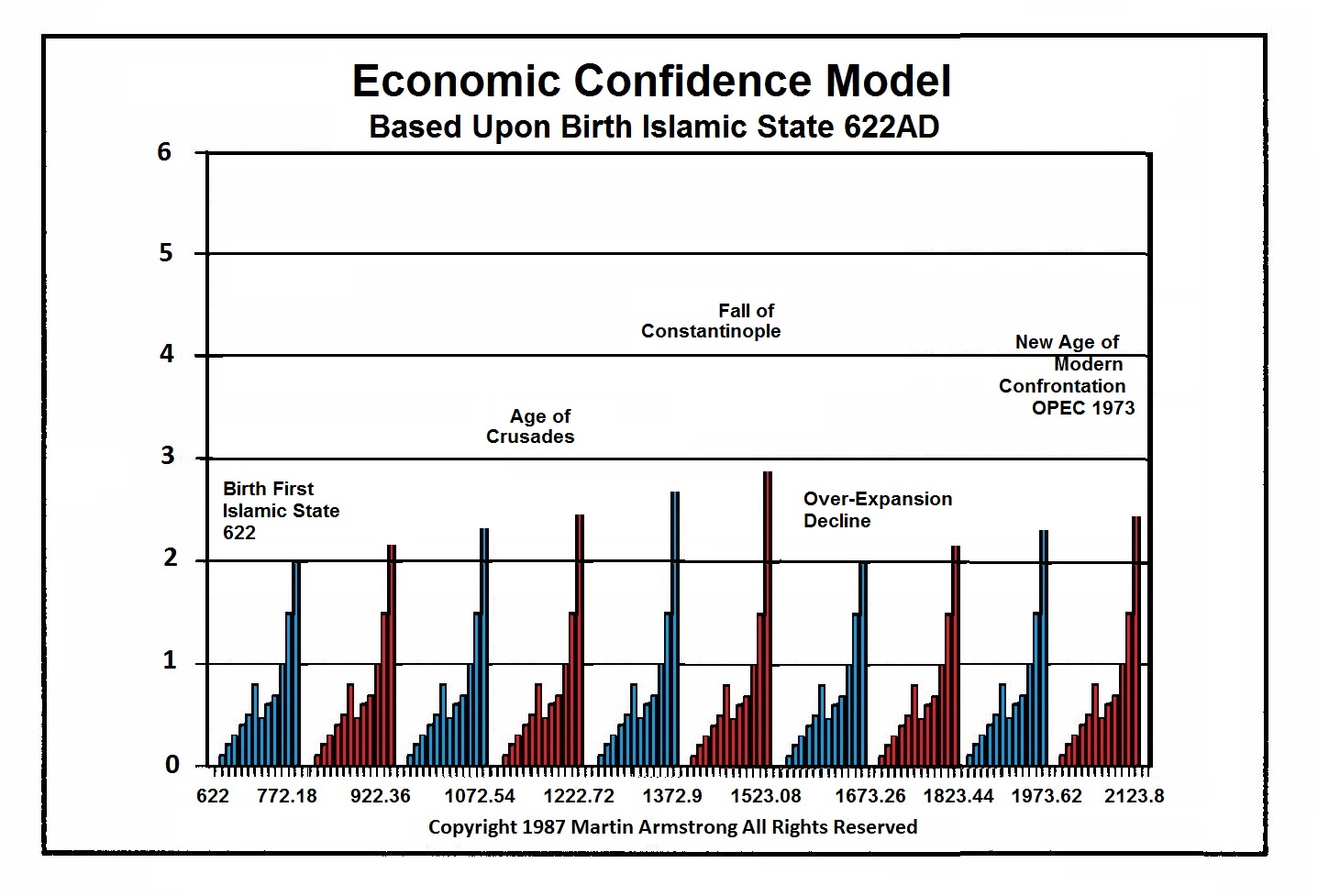
The migration of refugees to Europe is part of a long historical trend. The last invasion ended with the Battle of Vienna, which took place in Vienna on September 11, 1683, and concluded on the following day. The battle caused the first financial panic on that list of panics I stumbled upon which led to the discovery of the Economic Confidence Model.
This current migration, which some are calling an invasion, appears to be on time no matter what we call it. Whether it is a real invasion or fleeing from another Islamic civil war the results, to a large extent, are the same. The attempts of the Muslim world to invade Europe go back to the Battle of Tours in October 732 AD (also known as the Battle of Poitiers) led by Charles Martel (688-741 AD), the grandfather of Charlemagne. During the Battle of Tours, Martel stopped an invasion led by the Umayyad Caliphate, the second of four major Islamic caliphates established after the death of Muhammad. This particular caliphate was centered on the Umayyad dynasty rising directly from Mecca.

For
those unfamiliar with the history of Islam, there were rivalries
between the Arab tribes that caused civil unrest in the provinces
outside Syria. The Second Muslim Civil War (680–692 AD) occurred when
the leadership of the Umayyad clan shifted from the Sufyanid branch of
the family to the Marwanid branch. The failed invasion of Europe in 732
AD during the Battle of Tours led
to a decline in confidence of the leadership. The Berber Revolt of
740–743 AD closely followed this period. As a direct result of all this
warfare, the resources of government were exhausted. The Umayyads were
further weakened by the Third Muslim Civil War (744–747 AD) and were
finally defeated by the Abbasid Revolution in (750 BC–132 AD). One
branch of the family fled across North Africa to Al-Andalus and
established the Caliphate of Córdoba, which lasted until 1031 AD in
Spain.
So
has Europe imported a civil war? Clearly, the Western powers do not
understand history or the fact that the attempt to topple the Syrian
government will lead to total chaos. This is by no means in the best
interest of national security for Europe or the United States. This is a braindead war game with very serious consequences for it is not over territory; it involves religion with no borders.
Sorry – It’s Just Time.
NATO Warns Russia to End Air Strikes

Around
50 police officers were deployed to a refugee center in Hamburg last
week to respond to clashes that involved more than 200 Syrian and Afghan
refugees. People are fleeing to Europe from different countries while
retaining their ethnic differences.
Moreover, the Islamic battle in the Middle East is between Sunni and
Shiite branches, who to a large extent, do not even consider the other
to be a follower of Islam. Many are beginning to fear that the refugees
will export their religious war into the heart of Europe.
Punic Wars & the Economic Confidence Model

QUESTION: Mr Armstrong,
How does the ECM stack up against The Punic Wars which left the victor, Rome,the Mediterranean superpower and on the road to Empire?
Many thanks for sharing your historical knowledge.
JR

ANSWER: When I back tested the Economic Confidence Model, this frequency appeared over and over again throughout history in all cultures. Even the great reforms of Diocletian (284-305AD) saw a 52-year decline in the coinage in weight before another reform took place.
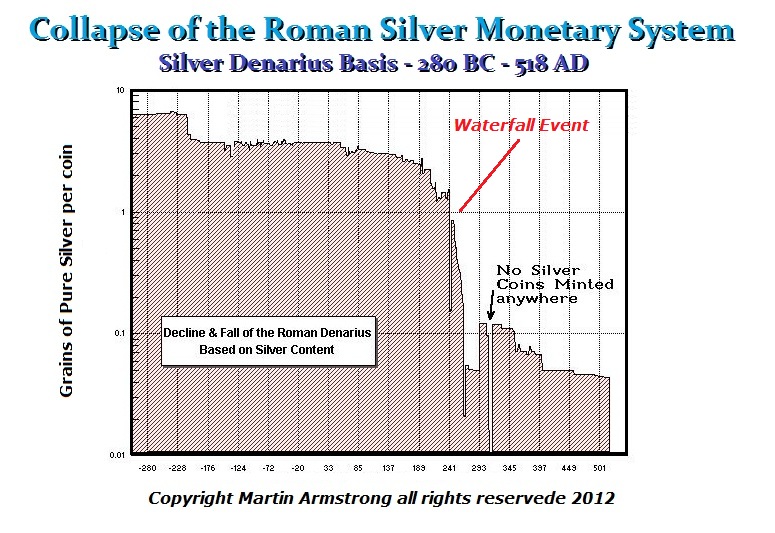
The sharp decline in the Roman monetary system during the 3rd century accelerated once Valerian I (253-260AD)
was captured by the Persians. It took just 8.6 years to collapse in
silver content from 55% to virtually zero. The overall decline from the
peak of the Roman Empire under Marcus Aurelius to the bottom was 86
years. From the start of the post-Depression socialistic/Marxist era
that began in 1934, interestingly enough that is the bottom of the
current wave in the ECM – 2020.

What caused the
total collapse in the Roman Monetary System? Was it inflation or lack of
confidence? It was the fact that Valerian was the first Roman Emperor
to ever be captured. This sent a shock wave through the empire where
people hoarded money, the economy contracted, and that resulted in the
government having to debase the money to pay its bills. As always, the CONFIDENCE evaporates FIRST and then the hyper-inflationary outcome results. It has NEVER been the other way around.
Looking
back during the Republican era, we see that in 270 BC, the
confrontation between Rome and Carthage began and lead to the outbreak
of a trade war in 264 BC, known as the First Punic War. Rome succeeded
in subjugating Italy in 270 BC when it recaptured Rhegium (southern
Italy) from the Mamertines and defeated the Brutians, Lucanians,
Calabrians and Samnites. Southern Italy was a trade link for Carthage.
The Romans restored the town of Rhegium to its original Greek
inhabitants. Carthage actually controlled Sardinia, southern Spain, and
Numidia along with Sicily. Carthage inherited their naval strength and
experience from their fore-bearers, the Phoenicians, and became a
powerful seafaring entity who really clashed with the Greeks for the
Mediterranean. Carthage was ruled by an oligarchy of merchants who
relied upon mercenaries for its soldiers.

The Sicilian Wars (Greek-Punic Wars) were a
series of confrontations between the Carthaginians and the Greek
city-states, which at the time were led by Syracuse. They were a contest
for control of Sicily and the western Mediterranean between 600 BC and
265 BC. Therefore, the Sicilian Wars were fought on the island of Sicily but did not involve Rome.


After
Agathocles of Syracuse sued for peace, Carthage enjoyed a brief and
unchallenged period of control over Sicily. However, Carthage’s control
of most of Sicily came to an end with the Pyrrhic War. This was the
second phase of Pyrrhic War (280–265 BC), which eventually led to the Roman-Punic Wars.
Pyrrhus of Epirus arrived in Sicily to rescue the island from
Carthaginians but was only partially successful and returned to Italy.
Only when Rome became involved in Sicily did the reign of the
Carthaginians come to an end in Sicily. Thus, the First Punic War
(264–241 BC) began in 264 BC after Pyrrhus retreated from Sicily.
Trade
effectively emerged as a major economic means of increasing the
national wealth in North Africa. The Punic Wars between Rome and
Carthage (known today as the suburb of Tunis, Tunisia) and the ancient
center of the Carthaginian Empire are indicative of this lucrative trade
based on the acquisition of wealth following the Minoan model. Even
after Rome soundly defeated Carthage during the First Punic War (264–241
BC), the city rose again because of trade. The First Punic War (264–241
BC) was a battle to control Sicily and Corsica. To defeat Carthage, the
Romans had to create a navy, and finally with a fleet of 200 ships they
compelled Carthage to yield.


During
the Second Punic War (218 –201 BC), Carthage gained land in Spain and
Hannibal led an ambitious campaign to defeat Rome. The Punic
Carthaginian military commander renewed the war by invading Italy by
land from the north over the Alps. This invasion caused Rome to issue
its first gold coins in an effort to convince the rest of Italy to
resist Hannibal. These were stated to conform to the Greek monetary standard.
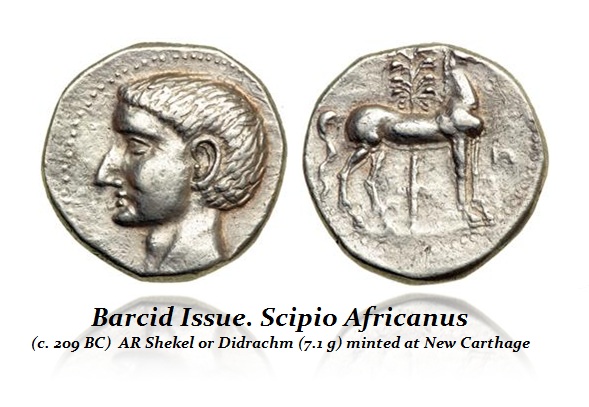
In
the end, Rome prevailed and the famous Roman statesman and General,
Scipio the Great (236–183 BC) took the war to Carthage. Scipio defeated
Hannibal and demanded an indemnity and the surrender of their entire
fleet. Coins were issued in the denomination of the Shekel of Northern
Africa with his portrait proudly displayed.
Nevertheless, the Carthaginians quickly recovered since their talent was trade.
The sheer ability of trade to rebuild the economy was an example to all
nations. This created the envy of Rome’s imitative merchant class who
could not yet compete in international trade. This envy is what sparked
the Third Punic War. Amazingly, the Third Punic War (149–146 BC) was
51.6 years from the defeat in 201 BC. The Second Punic War (218 –201 BC)
was 51.6 years from the conquest of Italy in 270 BC.
The
timing of the ECM in waves of 51.6 years has existed from ancient times
into the present. This has been a very interesting discovery, rather
than a theory.
No comments:
Post a Comment